About Thailand
The weather in July, what each region is like, and what to pack.

July and August are the middle of the rainy season, but it doesn't rain all day. Sometimes there's a shower for an hour or two and then it clears. Sometimes it pours at night and the next day is lovely.
The weather varies a lot by region. With some slack in your plans you'll enjoy it just the same, and the season has its upsides: fewer crowds, better prices on flights and hotels, and nature at its best, from jungles and mountains to national parks like Khao Yai or Khao Sok.
Around the wedding
The north is green, a bit like spring in Europe, and the waterfalls are full. It's the best time of year to be near the rivers. In Uttaradit, July days reach about 32–33 °C and nights about 25 °C, with rain on roughly every other day. Heavy rain can bring floods and landslides, so check conditions before a mountain trip or a waterfall. The wedding is at the hotel, so rain won't spoil it.
In the centre, around Bangkok and Ayutthaya, days are hot and humid, with a short afternoon downpour that clears quickly. Do temples and walks in the morning, and keep a café or museum for when it rains.
Beaches in July
This is where you need to choose carefully. The Samui islands in the Gulf (Koh Samui, Koh Phangan and Koh Tao) have their rainy season at a different time, so in July they're usually the best bet for beaches, snorkelling and diving. It can still rain or get rough there, so check the forecast and the boats.
The Andaman coast (Phuket, Krabi, Phang Nga, Phi Phi, Koh Lanta) gets heavy rain in July, waves of 2–3 metres and frequent boat cancellations. We wouldn't go unless you like taking chances. Travellers' YouTube videos show it well.
The eastern Gulf, with Koh Chang and Koh Kood, has similar weather. Pattaya is in the east too, though it varies there. Being in the Gulf of Thailand doesn't guarantee good weather.
Planning around July
Rain closes parks and trails and cancels boats, so check before you book an island or a mountain trip.
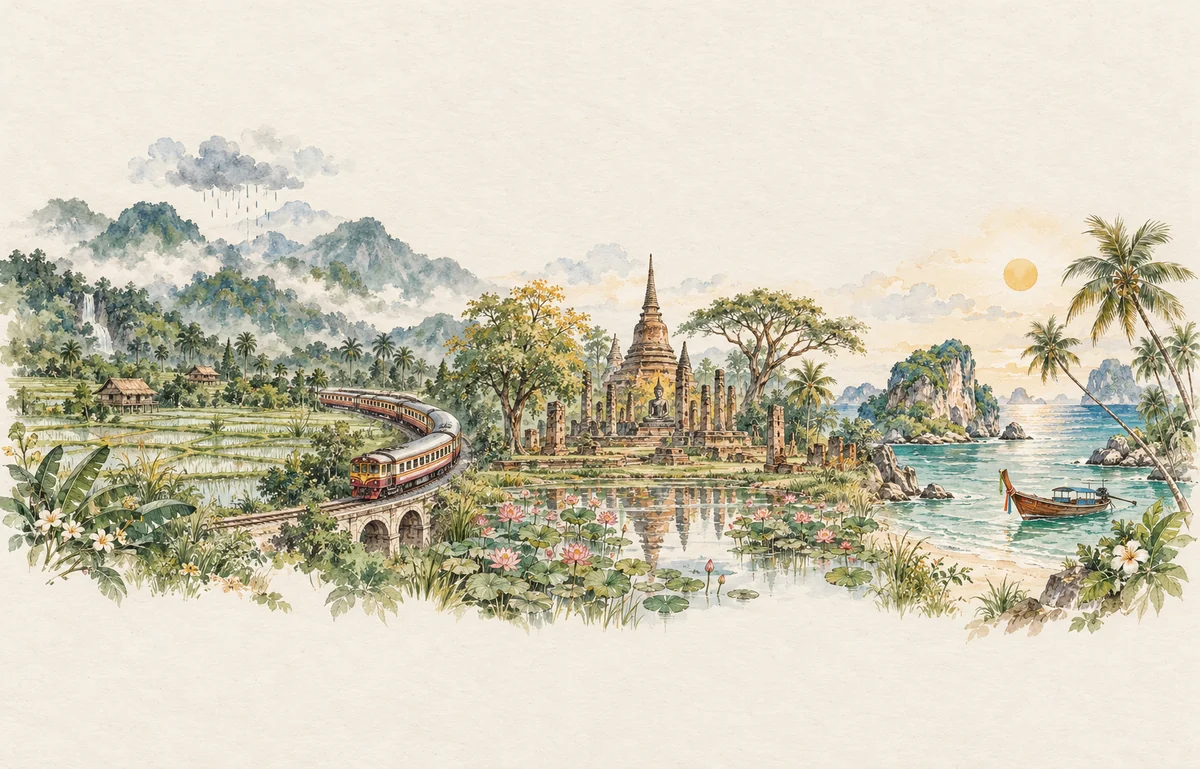
Close to the wedding is Sukhothai, the first capital of Siam. Its historical park, a UNESCO World Heritage Site, has temples and Buddhas among lotus ponds and is an easy drive from Uttaradit. If you'd like to see it, plan it for before or after the wedding.
The regions
If you stay longer, Thailand has a lot to offer. We'd pick a few places and take them slowly rather than rush through every region.
The north
Chiang Mai · Chiang Rai · Pai
Misty mountains, green valleys and national parks. Chiang Mai is the cultural centre, with historic temples, night markets and craft workshops. Chiang Rai has the White Temple, Wat Rong Khun, and is close to the Golden Triangle, where Thailand, Myanmar and Laos meet.
Near Chiang Mai you can spend a day with elephants at a sanctuary. Pick one where nobody rides them. The best known is Elephant Nature Park, about an hour and a half from the city, with hotel pickup.
Pai is a laid-back mountain town popular with hikers and backpackers, though it's getting busier. This is the region for trekking, temples and hill-tribe culture. In July it's green and wet. The cool weather comes in winter.
Bangkok and the central plains
Bangkok · Ayutthaya · Chao Phraya River
Bangkok, today's capital, is the country's political and economic centre. Don't miss the Grand Palace and Wat Pho, and there's nothing better than a sunset by the Chao Phraya with a martini.
Ayutthaya, the old kingdom's second capital and a UNESCO World Heritage Site, has royal temple ruins across the province and is an hour from Bangkok by train. Good for wandering, ruins, and a short boat or train trip.
Isan and the northeast
Khao Yai · Udon Thani · Khon Kaen
Plateaus, rice fields and the Mekong along the border with Laos. Udon Thani and Khon Kaen are good bases for getting off the usual routes, seeing Khmer ruins and eating properly spicy food.
Khao Yai, Thailand's oldest national park, sits between the centre and the northeast. It's another option for forest and wildlife alongside a few city days. In the rainy season, check access before you go.
The south, two different coasts
Koh Samui · Koh Phangan · Koh Tao · Krabi · Phuket
A narrow peninsula with two coastlines, limestone cliffs and white-sand islands. Each coast has its rainy season at a different time, so check which side your island is on. The Gulf has Koh Samui, Koh Phangan and Koh Tao, the diving island. That's where we'd look for a July beach trip.
The Andaman coast has Phuket, Krabi with Railay, Phi Phi, Koh Lanta and Phang Nga, and inland, Khao Sok National Park with its rainforest and lake. In July the sea there is rough and boats get cancelled.
The eastern coast
Pattaya · Koh Larn · Koh Chang · Koh Kood
Beaches a few hours from Bangkok, industrial towns and mountainous islands near Cambodia. Pattaya is a beach city with lots of nightlife and Koh Larn next door. Towards Cambodia are Koh Chang, big and rugged, and Koh Kood.
In July, Koh Chang and Koh Kood get a lot of rain. For beach days, the Samui islands are the better bet.
What to pack
- A small umbrella or a light rain jacket.
- Loose cotton or linen clothes. The humidity is usually 70–80%.
- Something that covers shoulders and knees for temples, and shoes that slip off easily.
- Sunscreen, sunglasses and a hat. The sun is strong even when it's cloudy.
- Mosquito repellent, especially in the evening.
Passport, money, phone and plugs are in Before you go. Maxi's own favourites are in Maxi's recommendations.